The Truth About College Success (And Why So Many Students Don’t Make It Back)
By Annapolis College Consulting

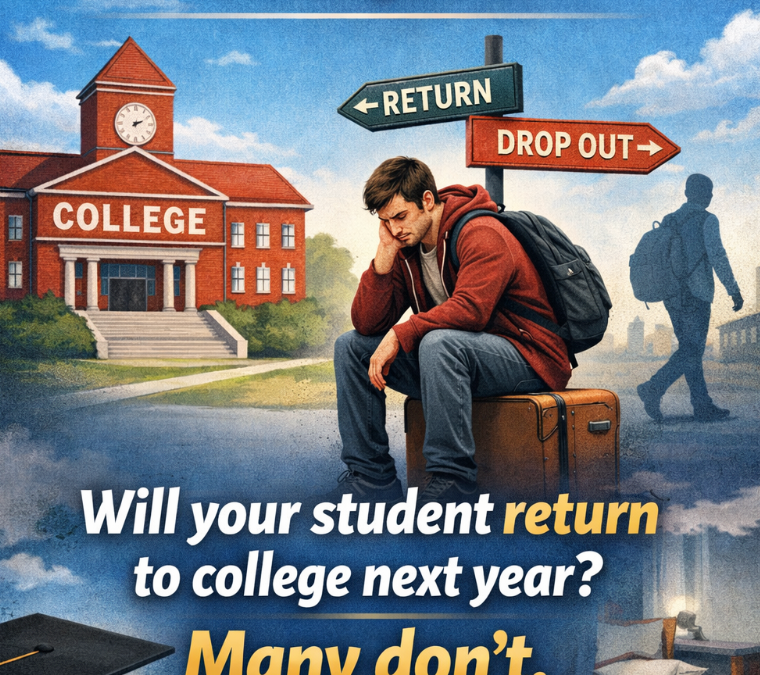
Spring semester is when reality sets in on college campuses. Students return from spring break and, for many freshmen, there is a quiet but important question in the background: am I coming back next year? This is the part of the college conversation that families do not hear enough about. Nearly one-third of freshmen do not return to their college for sophomore year, and about a quarter do not return to any college at all. These numbers are at a ten-year high, which should shift how families think about college admissions. The goal is not simply getting in. The goal is finding a place where a student will stay, grow, and graduate with real opportunities.
Nearly one-third of freshmen do not return to their college for their sophomore year, and about a quarter do not return to any college at all.
A recent article on The Next Generation of Student Success highlights a challenge that we see often in our work with students. Colleges have built extensive support systems over time, including advising, tutoring, mental health services, and career centers. However, these services are often not connected in a meaningful way. Students are expected to navigate multiple systems, offices, and processes on their own. Elliot Felix, in his book The Connected College, explains that institutions did not create ineffective systems intentionally. Instead, they added solutions over time without integrating them. The result is that help exists, but it is not always easy to access, and students can fall through the cracks despite the best intentions of the institution.
At the same time, families often misinterpret what their student is experiencing during the first year of college. In my conversation on the Tests and the Rest podcast, we discussed the W-Curve, a framework that describes the emotional journey of first-year students. Many universities, including the University of Miami, use this model to explain the transition to college life. Students typically begin with a period of excitement and optimism as they arrive on campus. This is followed by a stage where reality sets in. Academic pressure increases, social dynamics become more complex, and independence can feel overwhelming. Students then begin to adjust and find routines, but this is often followed by a second dip where feelings of isolation and doubt surface. This is the point where many students question whether they chose the right school or whether they truly belong. With time, most students move into a phase of acceptance and integration, where they find their place and build confidence. Miami Stats
The challenge is that families often respond most strongly during that low point in the W-Curve. What feels like a crisis is often a normal part of the adjustment process. Students are not failing. They are adapting. When families understand this pattern, they are better equipped to support their student without overreacting or encouraging premature decisions about transferring or leaving. This perspective is critical in helping students persist through the most difficult parts of the transition.
Higher education is also shifting in how it defines success. What was once focused primarily on retention and graduation is evolving into a broader view of student success that includes the entire college experience and the transition into a career. This shift reflects the realities of today’s world, where the path from college to career is less predictable and increasingly influenced by changes in the workforce, including the impact of technology and artificial intelligence.
Colleges are being pushed to think beyond helping students complete a degree and instead focus on helping them build a meaningful future.
For families of high school students, this means the college search process needs to change. It is no longer enough to focus on rankings or name recognition. The more important questions center on how a college supports students once they arrive. Families should be looking closely at freshman retention rates, the accessibility of academic and personal support services, the strength of first-year programming, and how well a college connects academics to career outcomes. Campuses that are intentionally designed to make support visible and accessible, often through centralized spaces like libraries that house tutoring, writing centers, advising, and career services, tend to create better outcomes for students.
The national first-year retention rate—the percentage of first-time, full-time undergraduate students returning to the same institution for their second year—recently reached a 10-year high of 68.2%, according to the National Student Clearinghouse Research Center. Generally, rates above 80-90% are considered strong, reflecting high student satisfaction and support.
 National Student Clearinghouse | +2
One of the biggest mistakes families make is choosing a college based on what looks impressive rather than what will function well for their student. A college may be highly ranked, but if a student struggles to find support or does not feel a sense of belonging, the likelihood of persistence decreases. The right college is not just one that admits a student. It supports the student through the inevitable challenges of the first year and beyond.
Preparation is not just about building a strong application. It is about understanding what success looks like once a student is on campus.
For families with sophomores and juniors in high school, this is the time to start thinking differently. The families who feel confident during senior year are those who have taken the time to build a thoughtful college list, one that reflects academic, social, and financial fit, as well as the strength of student support systems.
This is exactly why we created College Sharks. Families need clear, accessible guidance to navigate a process that has become more complex than ever. With the right strategy, students can find colleges where they are not only admitted but where they are positioned to succeed from the first day on campus through graduation and beyond. College Sharks is our DIY, video-based, asynchronous learning platform and workbook to help families help themselves.
Annapolis College Consulting has a robust 17-year history helping families one-on-one, whether with hourly packages or a comprehensive plan. We offer a free 30-minute consult to see what plan is right for your family.
Take a bite out of college admissions with us.
www.AnnapolisCollegeConsulting.com
www.CollegeSharks.com
Follow us for the best information and head over to Instagram @CollegeSharks for practical advice, real strategies, and a clear path forward.